What is your developer-dependent CMS actually costing you? Calculate your costs and get a full report


Search
Azure AI Search
Index Agility content in Azure AI Search with signed webhooks, then query it with keyword, semantic and hybrid vector search — or ground an AI assistant on it.
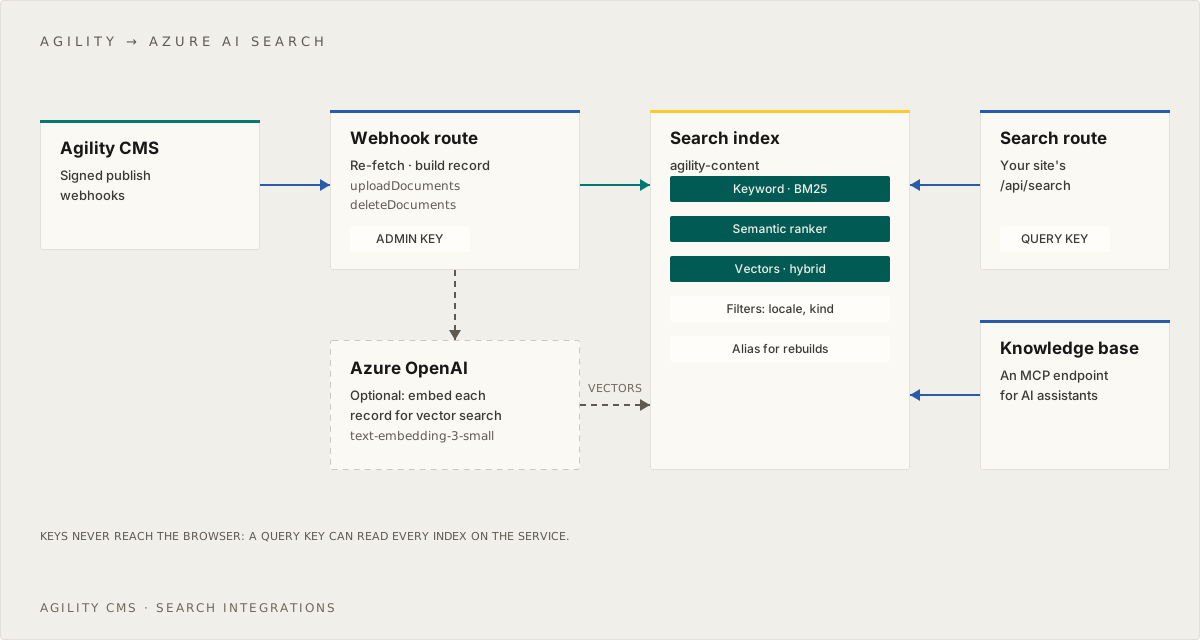
Azure AI Search is Microsoft's managed search service. It combines keyword search, a semantic ranker, vector and hybrid search, and knowledge bases that ground AI assistants on your content. If your team already runs on Azure, it keeps search in the same subscription, identity model and billing as everything else.
This guide builds on Indexing Agility Content for Search. Read that first. It covers the webhook, signature verification, re-fetching from the Fetch API, deletes and the full reindex, which are the same for every provider. This guide adds the Azure-specific parts.
Before you start
- An Azure subscription and an Azure AI Search service. Basic is the practical starting tier. Free (50 MB, 3 indexes) is fine to experiment with, but it's shared hardware, can be removed when inactive, and doesn't support managed identities.
- The service endpoint (
https://<service>.search.windows.net), an admin key for indexing and a query key for searching (Settings > Keys in the portal). - An Agility webhook with secure delivery on, set up as described in the indexing guide.
npm install @azure/search-documents
# .env.local
AZURE_SEARCH_ENDPOINT=https://<service>.search.windows.net
AZURE_SEARCH_INDEX=agility-content
AZURE_SEARCH_ADMIN_KEY=...   # server only: webhook + reindex
AZURE_SEARCH_QUERY_KEY=...   # server only: the search route
Push, not pull. Azure AI Search can pull data with indexers, but only from Azure data sources (Blob, SQL, Cosmos DB and so on). Agility isn't one. So you push documents from your webhook handler, which is also the only way to get changes into the index within seconds.
Create the index
Run this once, from a script or a deployment step. It mirrors the SearchRecord shape from the indexing guide.
// scripts/create-index.ts
import { SearchIndexClient, AzureKeyCredential, type SearchIndex } from "@azure/search-documents"

const indexClient = new SearchIndexClient(
  process.env.AZURE_SEARCH_ENDPOINT!,
  new AzureKeyCredential(process.env.AZURE_SEARCH_ADMIN_KEY!),
)

const index: SearchIndex = {
  name: process.env.AZURE_SEARCH_INDEX ?? "agility-content",
  fields: [
    { name: "id", type: "Edm.String", key: true, filterable: true },
    { name: "kind", type: "Edm.String", filterable: true, facetable: true },
    { name: "agilityId", type: "Edm.Int32", filterable: true },
    { name: "locale", type: "Edm.String", filterable: true, facetable: true },
    { name: "referenceName", type: "Edm.String", filterable: true, facetable: true },
    { name: "title", type: "Edm.String", searchable: true, analyzerName: "en.microsoft" },
    { name: "description", type: "Edm.String", searchable: true, analyzerName: "en.microsoft" },
    { name: "body", type: "Edm.String", searchable: true, analyzerName: "en.microsoft" },
    { name: "url", type: "Edm.String", filterable: true },
    { name: "updatedAt", type: "Edm.DateTimeOffset", filterable: true, sortable: true },
  ],
  suggesters: [{ name: "sg", searchMode: "analyzingInfixMatching", sourceFields: ["title"] }],
  semanticSearch: {
    defaultConfigurationName: "default",
    configurations: [
      {
        name: "default",
        prioritizedFields: {
          titleField: { name: "title" },
          contentFields: [{ name: "description" }, { name: "body" }],
        },
      },
    ],
  },
}

await indexClient.createOrUpdateIndex(index)
A few things to know:
- Keys can contain letters, digits,
-,_and=, can't start with_, and are case-sensitive. The indexing guide'sen-us-content-39format is valid as-is. - Analyzers set the language rules for stemming and stop words.
en.microsoftsuits English. For other locales, create one index per locale with the matching analyzer (fr.microsoft,es.microsoftand so on). - You can't change an existing field's type or analyzer. To change them, build a new index and switch to it (see Rebuilding without downtime).
Write to the index
This is the searchIndex object the webhook route and the reindex script import:
// lib/search/provider.ts
import { SearchClient, AzureKeyCredential } from "@azure/search-documents"
import type { SearchRecord } from "./types"

type AzureDoc = Omit<SearchRecord, "updatedAt"> & { updatedAt: Date }

const writeClient = new SearchClient<AzureDoc>(
  process.env.AZURE_SEARCH_ENDPOINT!,
  process.env.AZURE_SEARCH_INDEX ?? "agility-content",
  new AzureKeyCredential(process.env.AZURE_SEARCH_ADMIN_KEY!),
)

const toDoc = (r: SearchRecord): AzureDoc => ({ ...r, updatedAt: new Date(r.updatedAt) })

export const searchIndex = {
  async upsert(record: SearchRecord) {
    await writeClient.uploadDocuments([toDoc(record)], { throwOnAnyFailure: true })
  },

  async upsertMany(records: SearchRecord[]) {
    // At most 1,000 documents (or 16 MB) per request
    for (let i = 0; i < records.length; i += 1000) {
      await writeClient.uploadDocuments(records.slice(i, i + 1000).map(toDoc), { throwOnAnyFailure: true })
    }
  },

  async remove(id: string) {
    await writeClient.deleteDocuments("id", [id], { throwOnAnyFailure: true })
  },
}
Why these calls:
uploadDocuments, notmergeOrUploadDocuments. You always rebuild the whole record from Agility, anduploadreplaces the document completely.mergeOrUploadwould keep values for any field you've since stopped sending.throwOnAnyFailure: true. A batch can partly succeed, and by default the SDK returns per-document results rather than throwing. Throwing makes the webhook return a 500, so Agility retries.- Deletes are idempotent. Deleting a key that doesn't exist still succeeds, so a duplicate
Deletedwebhook is harmless.
Plug this into the route handler and reindex script from the indexing guide, and publishing in Agility now updates Azure AI Search.
Query from your site
Keep both keys on the server. A query key is service-wide: anyone who has it can read every index on the service, and there's no per-key rate limit. So put a small search route in front of the index rather than calling it from the browser:
// app/api/search/route.ts
import { SearchClient, AzureKeyCredential, odata } from "@azure/search-documents"
import type { SearchRecord } from "@/lib/search/types"

const queryClient = new SearchClient<SearchRecord>(
  process.env.AZURE_SEARCH_ENDPOINT!,
  process.env.AZURE_SEARCH_INDEX ?? "agility-content",
  new AzureKeyCredential(process.env.AZURE_SEARCH_QUERY_KEY!),
)

export async function GET(req: Request) {
  const url = new URL(req.url)
  const q = (url.searchParams.get("q") ?? "").slice(0, 200)
  const locale = url.searchParams.get("locale") ?? "en-us"
  if (!q) return Response.json({ count: 0, hits: [] })

  const results = await queryClient.search(q, {
    filter: odata`locale eq ${locale}`, // odata`` escapes user input
    queryType: "semantic",
    semanticSearchOptions: {
      configurationName: "default",
      captions: { captionType: "extractive", highlight: true },
    },
    select: ["id", "title", "description", "url", "kind"],
    top: 10,
    includeTotalCount: true,
  })

  const hits = []
  for await (const r of results.results) {
    hits.push({ ...r.document, caption: r.captions?.[0]?.highlights ?? r.captions?.[0]?.text })
  }

  return Response.json(
    { count: results.count, hits },
    { headers: { "Cache-Control": "s-maxage=60, stale-while-revalidate=300" } },
  )
}
The search route also lets you enforce the locale filter, cap query length, cache popular queries at the CDN and add rate limiting, none of which you can do from the browser.
About the semantic ranker: queryType: "semantic" re-ranks the top 50 keyword matches with a language model, and adds captions and answers. Every service includes 1,000 semantic queries a month free. After that, semantic queries fail with an error until you switch the service's semantic ranker plan to Standard (paid, Basic tier or higher) in the portal. Plan for this before launch. To go without the semantic ranker, remove queryType and semanticSearchOptions, and ask for highlightFields: "body" instead.
Search UI
Microsoft doesn't ship an InstantSearch-style UI library for Azure AI Search, and no maintained adapter exists. The route returns { count, hits } with a highlighted caption on each hit, which is exactly what the minimal search box in the indexing guide expects.
Captions contain only highlight tags from Azure around text from your own content. That makes them safe to render as HTML if your indexed text is already plain text, as the indexing guide's toText makes it.
Hybrid and vector search
Vector search finds results by meaning rather than exact words. That helps with questions ("how do I reset my password") and with synonyms your editors never wrote. Hybrid search runs keyword and vector queries together and merges the results, and it's the recommended default.
In the push model you generate the embeddings: Azure's integrated vectorization at indexing time only works with indexers. At query time, a vectorizer on the index embeds the query for you, so the frontend doesn't change.
- Add a vector field, a vectorizer and a profile to the index:
// in the index definition
fields: [
  // …existing fields…
  {
    name: "bodyVector",
    type: "Collection(Edm.Single)",
    searchable: true,
    hidden: true,
    vectorSearchDimensions: 1536,
    vectorSearchProfileName: "vector-profile",
  },
],
vectorSearch: {
  algorithms: [{ name: "hnsw", kind: "hnsw" }],
  vectorizers: [
    {
      vectorizerName: "openai",
      kind: "azureOpenAI",
      parameters: {
        resourceUrl: process.env.AZURE_OPENAI_ENDPOINT,
        deploymentId: process.env.AZURE_OPENAI_EMBED_DEPLOYMENT,
        modelName: "text-embedding-3-small",
        apiKey: process.env.AZURE_OPENAI_KEY,
      },
    },
  ],
  profiles: [{ name: "vector-profile", algorithmConfigurationName: "hnsw", vectorizerName: "openai" }],
},
- Embed each record before you upload it, using the same model the vectorizer uses:
// lib/search/embed.ts
import OpenAI from "openai"

const openai = new OpenAI({
  baseURL: `${process.env.AZURE_OPENAI_ENDPOINT}/openai/v1/`,
  apiKey: process.env.AZURE_OPENAI_KEY!,
})

export async function embed(texts: string[]) {
  const res = await openai.embeddings.create({ model: process.env.AZURE_OPENAI_EMBED_DEPLOYMENT!, input: texts })
  return res.data.map((d) => d.embedding)
}
// in searchIndex.upsert
const [bodyVector] = await embed([`${record.title}\n\n${record.body}`.slice(0, 8000)])
await writeClient.uploadDocuments([{ ...toDoc(record), bodyVector }], { throwOnAnyFailure: true })
- Add a vector query next to the text query:
vectorSearchOptions: {
  queries: [{ kind: "text", text: q, fields: ["bodyVector"], kNearestNeighborsCount: 50 }],
},
Set kNearestNeighborsCount to at least 50, because the semantic ranker re-ranks the top 50 results. Hybrid scores are small numbers (around 0.03), which is normal for the fusion method Azure uses.
Embedding adds time and cost to every publish. It's usually still well within the 30-second webhook timeout. If it isn't, acknowledge the webhook first and embed afterwards (see the indexing guide). If you change the embedding model or its dimensions, you need a new index.
Long content: one vector per page loses detail on long articles. For AI assistants in particular, split the body into passages of about 2,000 characters with some overlap. Index each passage as its own document (en-us-content-39-0, -1, …) with a parentId field. Azure has no delete-by-query, so to remove an item, search for its parentId and delete the returned keys.
Ground an AI assistant on your content
Azure AI Search knowledge bases (GA in REST API 2026-04-01) turn an index into a retrieval endpoint for AI agents. Each knowledge base is also an MCP server, so assistants such as Microsoft Foundry agents, GitHub Copilot, Claude and Cursor can use your Agility content as a tool, with no extra code.
import { SearchIndexClient, KnowledgeRetrievalClient, AzureKeyCredential } from "@azure/search-documents"

const endpoint = process.env.AZURE_SEARCH_ENDPOINT!
const indexClient = new SearchIndexClient(endpoint, new AzureKeyCredential(process.env.AZURE_SEARCH_ADMIN_KEY!))

await indexClient.createOrUpdateKnowledgeSource({
  name: "agility-content",
  kind: "searchIndex",
  searchIndexParameters: {
    searchIndexName: "agility-content",
    semanticConfigurationName: "default", // required
    sourceDataFields: [{ name: "title" }, { name: "url" }],
  },
})

await indexClient.createOrUpdateKnowledgeBase("agility-kb", {
  name: "agility-kb",
  knowledgeSources: [{ name: "agility-content" }],
})

// Retrieve grounding passages from your own chat route…
const kb = new KnowledgeRetrievalClient(endpoint, "agility-kb", new AzureKeyCredential(process.env.AZURE_SEARCH_QUERY_KEY!))
const res = await kb.retrieve({
  intents: [{ type: "semantic", search: "How do I return a product?" }],
  knowledgeSourceParams: [
    { kind: "searchIndex", knowledgeSourceName: "agility-content", filterAddOn: "locale eq 'en-us'", includeReferences: true },
  ],
})
…or point an MCP client at https://<service>.search.windows.net/knowledgebases/agility-kb/mcp?api-version=2026-04-01, authenticated with a Microsoft Entra token that has the Search Index Data Reader role.
The GA API returns extractive passages for your own model to answer from. LLM query planning and synthesized answers are still in preview (2026-08-01-preview). Agentic retrieval is billed separately from the semantic ranker and has its own monthly free allowance.
Rebuilding without downtime
Build the new index under a versioned name (agility-content-v2), run the full reindex into it, then point an index alias (agility-content) at it and delete the old one. Queries that use the alias switch over atomically. Aliases are GA in REST 2026-04-01 (indexClient.createOrUpdateAlias). They aren't available on the preview Serverless tier.
Using Microsoft Entra ID instead of keys
For production, you can turn off keys and use role-based access instead: Search Index Data Contributor for the indexing code and Search Index Data Reader for the search route. Swap AzureKeyCredential for DefaultAzureCredential from @azure/identity, and run those routes on the Node.js runtime, not Edge. Outside Azure, for example on Vercel, supply a service principal through AZURE_CLIENT_ID, AZURE_TENANT_ID and AZURE_CLIENT_SECRET. Custom roles can also limit access to a single index, which keys can't do.
Troubleshooting
- The webhook returns 500 with a per-document error. Check the key (invalid characters, a leading
_) and the field types. A string sent toEdm.Int32, or a date that isn't ISO 8601, fails that one document. - Semantic queries suddenly fail. The free 1,000 monthly queries are used up. Switch the semantic ranker plan to Standard.
- Deleted content still appears for a minute. Deletes are applied asynchronously. They're usually gone within seconds, occasionally minutes.
- A result is stale. Check the webhook's History in Agility, then run the reindex. See Debugging.
Learn more
On this page